
How Stop Loss & Trailing Stop Loss Work
Every exit rule answers the same question: what evidence would show the original idea was wrong? A stop loss answers it with price. What each of the two kinds measures, how an end-of-day model actually executes them, and the specific things neither can promise.
What You’ll Learn
By the end of this article, you’ll understand:
- The question every exit rule answers, and how a stop answers it with price alone
- What a Fixed Stop Loss measures from, and why it goes quiet as a position rises
- How a Trailing Stop follows the peak, and what that sensitivity costs
- Why a NiveshBuddy stop is a rule checked on a close, not an order resting at a price
- Why the price that triggers an exit is not the price you exit at
- Why neither a tighter nor a wider stop is the cautious choice
Every exit rule answers one question
You bought a stock because your rules said it qualified. At some point you will sell it. The interesting question is what makes you sell — and every exit rule ever written is an answer to the same thing:
What evidence is strong enough to admit my original idea was wrong?
Different rules answer it with different evidence. An exit based on ranking says the evidence is that better candidates now exist. An exit based on time says the evidence is that enough time has passed.
A stop loss gives the bluntest answer of all: the evidence is the price itself. If it has fallen far enough, that is treated as sufficient reason to close the position — regardless of the story, the company, or how convinced you were when you bought.
That bluntness is the whole point. Deciding in advance what a decline means removes the decision from the moment it is hardest to make well. It is also the weakness, because price falls for many reasons and a stop cannot tell them apart.
The two stop rules below differ in exactly one respect: what they measure the fall against.
Stop Loss: measured from where you started
The plain version. You set a percentage, and it is measured from your entry price. Fall further than that below what you paid, and the position closes.
Enter at ₹100 with a 10% stop and the threshold is ₹90. It is ₹90 the following week and ₹90 six months later. Nothing the position does in the meantime moves it.
The answer this encodes is: I accepted this idea at ₹100, and a fall of more than 10% from there is enough to tell me I was wrong. It is a statement about your entry, and it stops being informative once the position has moved well away from it — a stock at ₹150 is nowhere near a ₹90 threshold, so the rule has effectively gone quiet.
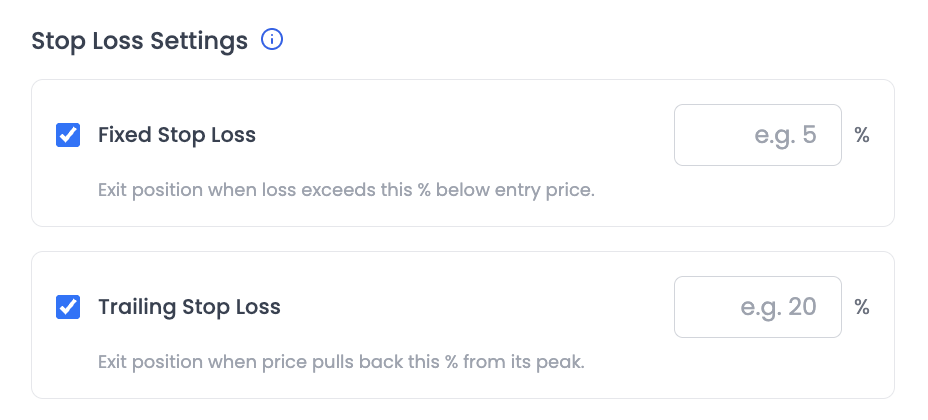
In NiveshBuddy this is the Fixed Stop Loss checkbox, and the product describes it as "Exit position when loss exceeds this % below entry price."
Trailing Stop Loss: measured from the best point reached
The trailing version measures the same kind of fall from the position's peak rather than from your entry. As the price rises the threshold rises with it, and it never falls back.
The same position, entered at ₹100 with a 10% trailing stop, starts with the threshold at ₹90 too. But if the price reaches ₹150, the threshold lifts to ₹135 and stays there.
The answer this encodes is different: whatever this position has achieved, giving back more than 10% of it means the move I was riding has ended. It converts part of an unrealised gain into a level the position will not fall through without closing — and, unavoidably, it also closes positions that dip and would have recovered.
The product's wording: "Exit position when price pulls back this % from its peak."
Both live under Stop Loss Settings in the Custom Strategy Builder's Portfolio Settings step, as two independent checkboxes. Both are off by default, and the Quick Strategy presets set neither — a quick strategy carries no stop unless you Customize it and tick one. When a stop does fire, the trade log's Exit Reason column says so in a sentence — for a 5% Fixed Stop Loss, "Stop-loss hit (5% below entry)".
| Fixed Stop Loss | Trailing Stop Loss | |
|---|---|---|
| What you enter | A single percentage | A single percentage |
| Measured against | The entry price | The position's peak |
| Does the threshold move? | No — set once, at entry | Yes — it rises with the price, and never falls |
Three details worth having:
Both are off unless you turn them on. A strategy built without touching them
reports Stop Loss: None, which is an ordinary strategy rather than an oversight.
They are independent, not alternatives. Both boxes can be ticked at once, so a strategy may carry either, both, or neither.
The greyed numbers are examples, not defaults. The fields render empty, with
e.g. 5 and e.g. 20 as placeholder text. Nothing is pre-selected and no
percentage is put forward as typical.
How the exit actually happens
If you have placed a stop loss through a broker, you likely met it as an order — something resting in the market that fires the moment a price trades.
A NiveshBuddy stop is not that. It is a rule evaluated once a day, against a closing price, and it is worth unlearning the order model before reading any further.
What happens when a stop condition is met
- The closing price is checkedThe condition is evaluated using a trading day's end-of-day close
- An exit signal is generatedAfter that close — not during the trading session
- The exit executesAt the next trading day's closing price
Two consequences follow, and every limitation below comes from one of them.
The threshold is checked against a close. A price touched at eleven in the morning and recovered by three in the afternoon triggers nothing, because the closing price is the only one the rule ever sees.
The exit happens a day later. Once a signal exists it is acted on at the following day's close. A full trading day passes in between, and the market does whatever it does.
So a 10% stop does not mean exiting down 10%. It means the exit process begins when a close falls below that level. Where the position actually ends up is settled by the next day's close.
What a stop cannot do
Four things worth being clear about
It does not cap your loss
The gap between the close that triggers the signal and the close that executes it can be large. The percentage you set is where the process starts, not a floor under the outcome.
It does not guarantee an exit price
You exit at whatever the next day's closing price turns out to be. There is no order resting at your threshold and no price you are promised.
It does not watch the day
Intraday movement is invisible to the rule. A sharp fall that recovers before the close is not a trigger, and a quiet drift that ends below the level is.
It does not know why the price fell
A stop is arithmetic on price. It cannot separate a company in trouble from a broad market decline from ordinary fluctuation, and it exits identically in all three.
Worth stating plainly: a stop loss is a rule for when a position ends, not a protection mechanism. It changes the shape of a strategy's losses — often more small ones and fewer large ones — without removing them, and without promising any particular amount.
Neither setting is the cautious one
It is tempting to treat a tighter stop as the careful choice. It isn't; it is a different trade.
Tighter means acting sooner on a genuine decline, and also acting on ordinary fluctuation that would have recovered. That second outcome is a whipsaw, and its cost is real: you take the loss, the position recovers without you, and the strategy may re-enter later at a higher price.
Wider, or none at all, means sitting through more fluctuation without acting, and letting an individual position fall a long way before anything happens. Some strategies are built for exactly that, particularly those relying on a few large winners to carry the result.
Two things that are easy to miss:
- A stop is not your only exit. Exit Rank closes a position whose ranking has fallen below a threshold — a different answer to the opening question, and one that can act while the price is still rising. A strategy without a stop is not a strategy without exits.
- Only the two stops are checked every day. Fixed and Trailing Stop Loss are evaluated on every trading day's close. Every other exit — Exit Rank, or a holding failing the strategy's filters, such as a Super Trend Filter — is evaluated only on rebalance day, as part of that rebalance.
- Adding a stop makes it a different strategy. Two otherwise identical rule sets, one with a stop and one without, will produce different trade counts, holding periods and drawdowns. Compare them as alternatives, not as one improved.
A worked example, start to finish
Everything above, on one position. The figures are illustrative and chosen to make the mechanics visible.
A stock is bought at ₹100, carrying both stops at 10%: a Fixed threshold at ₹90, and a Trailing threshold that starts at ₹90 and follows the peak.
| Trading day | Close | Fixed threshold | Trailing threshold | What the rule does |
|---|---|---|---|---|
| Entry | ₹100 | ₹90 | ₹90 | Position opened |
| … | rises to ₹150 | ₹90 | lifted to ₹135 | Trailing threshold follows the peak up |
| Day 20 | ₹138 | ₹90 | ₹135 | Above both — nothing happens |
| Day 21 | ₹132 | ₹90 | ₹135 | Below the trailing threshold — signal generated after this close |
| Day 22 | ₹127 | ₹90 | — | Exit executes at this close: ₹127 |
Four things this shows at once.
The Fixed stop never came close. At ₹90 it was irrelevant from the moment the price passed ₹110, and it would have carried this position all the way back to ₹90 before acting.
The trailing threshold moved once and stayed. It rose to ₹135 with the peak and did not drop when the price fell to ₹138.
Day 21 is a signal, not an exit. The rule saw a close of ₹132 against a ₹135 threshold. Nothing was sold that day.
The exit price is ₹127, not ₹132 and not ₹135. The position closed at the next day's close, wherever that landed. Here it fell further overnight, so the outcome was worse than the trigger — it could equally have recovered and been better. That gap is the model working as designed, not a malfunction, and it is precisely why a stop cannot promise an exit price.
Key takeaways
- Every exit rule answers the same question — what evidence would show the original idea was wrong. A stop loss answers it with price alone.
- A Fixed Stop Loss measures the fall from your entry price and never moves; it goes quiet once a position has risen well away from it.
- A Trailing Stop measures the fall from the position's peak, rising with the price and never falling back.
- Both are optional and off by default, both take a single percentage, and both can be enabled at once.
- A NiveshBuddy stop is a rule, not an order: it is checked against a closing price, the signal follows that close, and the exit executes at the NEXT trading day's close.
- Nothing happens intraday — a level touched and recovered within a day is not a trigger, and the price that triggers an exit is not the price you exit at.
- A stop does not cap a loss or guarantee an exit price; it changes the shape of a strategy's losses rather than removing them.
- Tighter stops act sooner on real declines and also on recoveries that were about to happen. Neither tighter nor wider is the cautious setting.